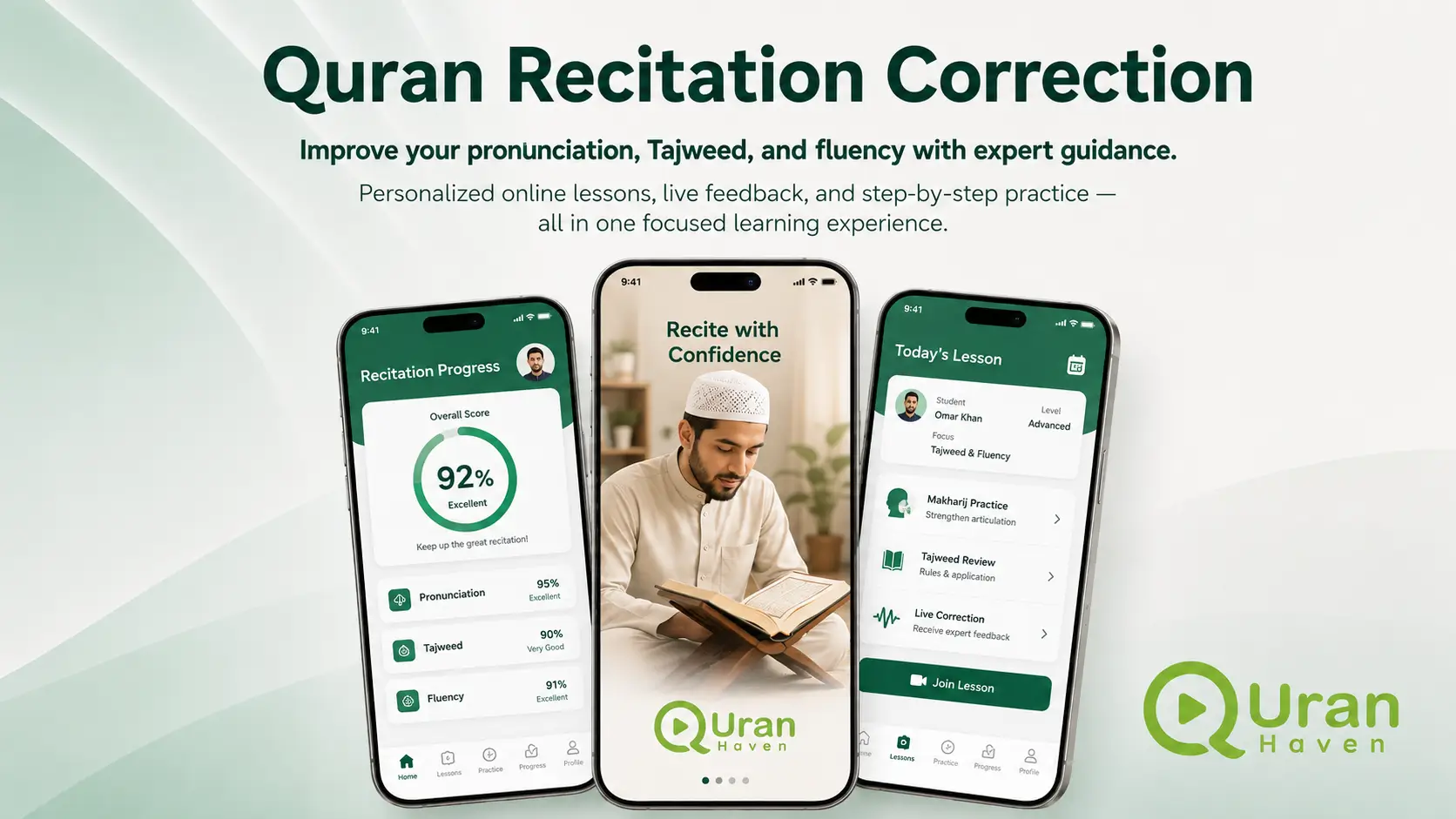
Quran Recitation Correction: A Practical Guide to Better Tilawah
Quran recitation correction is the process of identifying mistakes in pronunciation, Tajweed, rhythm, stopping, and fluency, then replacing them with accurate recitation through guided practice. Many learners can read Arabic words but remain unsure whether every letter, vowel, and pause is correct. A clear correction plan helps turn that uncertainty into steady, measurable progress.
Improvement does not require rushing through many pages or learning every Tajweed rule at once. It begins with careful listening, slow recitation, immediate feedback, and consistent repetition. When students work on one type of mistake at a time, correct recitation becomes easier to understand and maintain.
This guide explains the most common recitation problems, how a teacher corrects them, and how children and adults can build a practical routine for clearer, more confident Tilawah.
What Does Quran Recitation Correction Mean?
Quran recitation correction is more than being told that a word was read incorrectly. Effective correction explains where the mistake happened, why it happened, how the correct sound is produced, and what the learner should repeat to prevent the error from returning.
A complete correction lesson may focus on several connected areas
Pronouncing each Arabic letter from its correct articulation point.
Giving short vowels and Sukoon their proper sound.
Applying essential Tajweed rules without exaggeration or omission.
Observing appropriate elongation in Madd.
Using correct nasalization where Ghunnah applies.
Stopping and beginning at suitable places.
Reading smoothly without sacrificing accuracy.
The purpose is not to make a student afraid of mistakes. It is to help the learner hear differences more clearly, understand the correction, and repeat the right form until it becomes natural.
Why Correct Recitation Matters
A repeated mistake can become a strong habit. The longer it is practiced, the more effort it may take to replace it. Early Quran recitation correction gives learners a more reliable foundation before they increase their reading speed or begin memorizing longer passages.
Correct recitation also builds confidence. A learner who understands how letters are formed and why a rule is applied can approach unfamiliar verses with greater awareness. Instead of guessing, the student has a method for listening, checking, and improving.
For students memorizing the Quran, correction is especially valuable. Memorizing a verse with accurate pronunciation reduces the need to relearn it later and helps connect memorization with sound recitation.
Common Quran Recitation Mistakes
Confusing Similar Arabic Letters
Several Arabic letters may sound similar to a beginner, especially when the same distinction does not exist in the learner’s first language. Common examples include ح and ه, ع and أ, ص and س, ط and ت, ض and د, and ق and ك.
The solution is not simply to repeat the entire verse faster. The teacher isolates the difficult letter, demonstrates its articulation point, compares it with the similar sound, and then returns it to the word and verse.
Weak Makharij
Makharij are the articulation points from which Arabic letters are produced. A student may recognize a letter visually while producing it from the wrong part of the mouth or throat.
Correction begins by slowing down. The learner practices the letter on its own, then with different vowels, then inside selected words. This focused sequence makes the sound easier to control than repeating a long passage without understanding the source of the error.
Incorrect Short Vowels and Sukoon
Changing a Fathah, Kasrah, Dammah, or Sukoon can alter the sound and structure of a word. These errors often happen when a learner reads too quickly, relies on memory instead of looking carefully, or has not yet developed strong Arabic reading foundations.
A useful correction method is to point to each letter while reading slowly, keep the sound brief where the vowel is brief, and repeat the word accurately before reconnecting it to the verse.
Madd That Is Too Short or Too Long
Madd refers to elongation. Learners may shorten a sound that needs extension or stretch a natural vowel more than necessary. Counting with the teacher and repeating selected examples helps develop consistent timing.
The goal is controlled recitation, not an artificial melody. Learners should first master the required timing at a comfortable speed before trying to imitate a more advanced recitation style.
Missing or Exaggerating Ghunnah
Ghunnah is a nasal sound connected with specific rules involving Noon and Meem. Some learners remove it almost completely, while others extend it excessively.
A teacher can demonstrate the correct sound, duration, and place of resonance, then compare a correct example with the student’s attempt. Short drills are usually more effective than repeating many verses without focused feedback.
Weak Qalqalah
Qalqalah is an echoing quality associated with specific letters when they carry Sukoon. A common mistake is making the sound too weak, adding a full vowel, or exaggerating the bounce.
Correction should preserve the letter clearly without turning it into another syllable. Practicing a few carefully selected words helps the learner hear the balance.
Incorrect Stopping and Starting
Some students stop only when they run out of breath. Others pause too frequently, breaking the flow of the verse. Learning common Waqf signs and planning the breath before recitation can improve both clarity and continuity.
Students should also learn where to begin after a pause. A qualified teacher can explain which stopping points are suitable for the learner’s current level and help prevent awkward or confusing breaks.
Reading Too Fast
Speed can hide errors. When a learner rushes, letters become unclear, vowels disappear, and Tajweed rules are missed. The first priority should be accuracy at a slow, manageable pace.
Fluency develops after correct patterns become consistent. A slower accurate recitation is more useful for improvement than a fast recitation filled with repeated mistakes.
A Step-by-Step Quran Recitation Correction Method
Step 1: Begin With an Assessment
The teacher listens to a short passage and identifies patterns rather than interrupting every few seconds without a plan. The assessment may reveal that the learner needs to focus first on Arabic reading, a group of similar letters, basic Tajweed, or stopping and fluency.
Step 2: Prioritize the Most Important Mistakes
Trying to correct everything in one lesson can overwhelm the student. A better approach is to choose one or two priorities. For example, the learner may work on heavy and light letters during one stage, then move to Madd and Ghunnah after the first skill becomes more stable.
Step 3: Listen to a Clear Model
The student listens to the teacher recite the target word or verse at a suitable speed. Listening helps the learner notice articulation, vowel length, rhythm, and stopping before attempting the passage again.
Students can also use Quran. com as a convenient listening and reading resource between lessons. Audio is valuable for review, while live feedback remains important because a recording cannot always explain the learner’s individual mistake.
Step 4: Isolate the Difficult Sound
If a letter is incorrect, repeating the full verse may reinforce the same mistake. The teacher separates the sound, practices it with vowels, places it in a word, and finally reconnects the word to the verse.
This progression makes correction specific. The student knows exactly what to practice instead of receiving a general instruction to “read better. ”
Step 5: Repeat With Immediate Feedback
The learner repeats a short portion and receives correction immediately. Quick feedback prevents the wrong form from being repeated many times. The student should then recite the corrected word or phrase several times without assistance.
Step 6: Connect the Corrected Passage
After individual words are accurate, the student connects them into a complete phrase or verse. This stage checks whether the correction remains stable during natural recitation rather than only in an isolated drill.
Step 7: Review the Same Skill Later
A correction is not complete because it was performed correctly once. The teacher revisits the same sound or rule in a later lesson and checks it in new verses. Spaced review helps turn conscious correction into a lasting habit.
How to Practice Quran Recitation at Home
A short daily routine can support Quran recitation correction between lessons. The routine should be focused enough to repeat consistently.
Spend two minutes reviewing the teacher’s previous notes.
Listen to the assigned verses while following the Mushaf.
Recite slowly and mark any word that feels difficult.
Repeat the difficult word separately before reading the full verse.
Record one short recitation and listen for the target mistake.
End by reciting the corrected passage from beginning to end.
Ten to twenty focused minutes can be more productive than a long, distracted session. The exact duration should match the learner’s age, level, and concentration.
Learning Tajweed Without Feeling Overwhelmed
Tajweed becomes easier when rules are connected to real recitation. Instead of memorizing many definitions without practice, the learner can study one rule, hear it in several examples, apply it in a short passage, and receive correction.
Beginners may start with accurate letter pronunciation, short vowels, Sukoon, basic Madd, Ghunnah, and Qalqalah. More detailed rules can be introduced gradually as reading becomes stronger.
The aim is practical understanding. A student should be able to recognize the rule, hear its effect, and apply it while reading—not only repeat its name.
Can Adults Improve Quran Recitation?
Adults can make strong progress when lessons are adapted to their starting point. Some adults read fluently but need Tajweed correction. Others need to rebuild Arabic letter recognition and blending before working on advanced rules.
Progress may feel slow at first because familiar habits are being changed. Patient repetition and specific feedback are more useful than embarrassment or comparison. A structured plan allows adults to improve one skill at a time while maintaining motivation.
Quran Recitation Correction for Children
Children benefit from short drills, clear demonstrations, and positive correction. Lessons should protect the child’s confidence while still addressing mistakes accurately.
A teacher may use repetition, visual mouth-position guidance, listening exercises, and small reading goals. Parents can support the process by maintaining a regular lesson schedule and encouraging assigned revision without correcting every sound themselves.
The amount of practice should match the child’s attention span. Consistency and a positive learning experience are more important than completing a large number of pages.
Why One-to-One Online Lessons Can Help
Quran recitation is a listening and performance skill. In a one-to-one lesson, the teacher can hear every student attempt, pause immediately when a mistake occurs, demonstrate the correction, and adjust the exercise to the learner’s needs.
Personalized lessons also make it easier to track recurring errors. A student who struggles with Makharij needs a different plan from someone whose main challenge is Waqf, Madd, or reading speed.
Families and adult learners can explore the Quran Haven Quran with Tajweed program for personalized online instruction focused on pronunciation, Tajweed, and confident recitation.
How to Measure Recitation Progress
Progress should be measured by observable improvements rather than speed alone. Useful signs include:
Fewer repeated pronunciation mistakes.
Clearer distinction between similar letters.
More consistent Madd and Ghunnah.
Better awareness of stopping signs.
Ability to correct a mistake after recognizing it.
Smoother recitation at a controlled pace.
Greater confidence when reading an unfamiliar passage.
Keeping brief notes after each lesson helps the student remember what to practice. A monthly recording of the same short Surah can also make improvement easier to hear.
Habits That Slow Down Improvement
Some practice habits create activity without meaningful progress. Avoid reading large amounts while ignoring repeated mistakes, changing teachers or methods too frequently, practicing only before a lesson, or focusing on melody before pronunciation is stable.
Learners should also avoid comparing their pace with someone at a different level. Quran recitation correction is personal. The most useful comparison is between the learner’s current recitation and their own earlier performance.
How Quran Haven Supports Recitation Improvement
Quran Haven lessons are designed around the individual learner’s reading ability, goals, and recurring mistakes. A teacher can combine Quran reading, Makharij practice, applied Tajweed, stopping guidance, and fluency exercises in one structured plan.
A beginner may focus on letters and short words. An intermediate student may correct Tajweed and pausing. A more fluent reader may work on consistency, precision, and confident recitation across longer passages.
This personalized approach keeps correction practical. Students learn what the mistake is, how to fix it, and how to practice the corrected form between lessons.
Build Clearer and More Confident Quran Recitation
Improving recitation is a gradual process of listening, correction, repetition, and review. The strongest results come from identifying specific mistakes, practicing them slowly, and returning to them until the correct form becomes consistent.
With patient guidance and a realistic routine, children and adults can strengthen pronunciation, apply Tajweed more accurately, improve fluency, and recite with greater confidence.
Start your Quran recitation correction journey with Quran Haven and choose personalized one-to-one lessons that match your current level and learning goals
Explore our online Quran programs for personalized recitation correction and Tajweed guidance.